
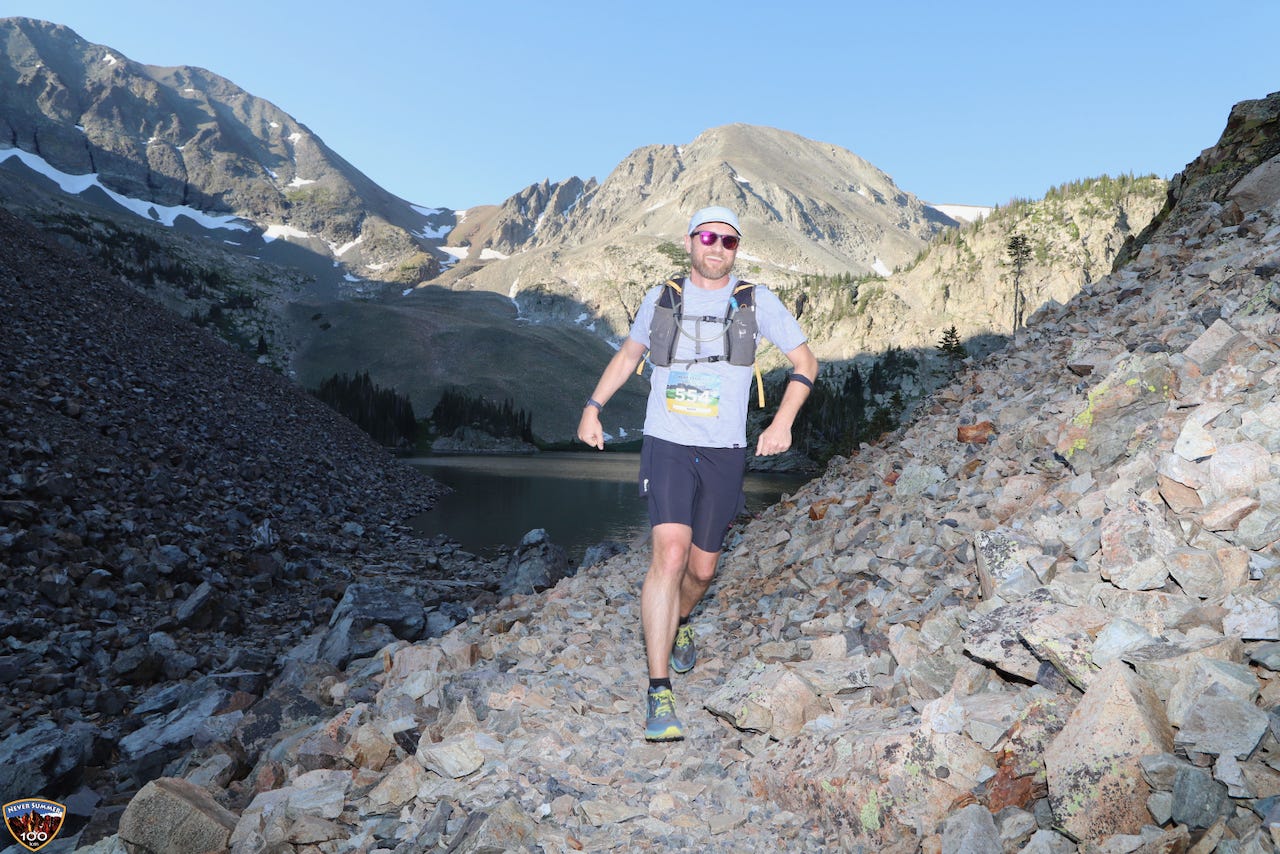
In 2024, I ran my first ultramarathon: the Never Summer 60k. Taking place at altitude (between ~8,500 and ~11,900 feet) and with over 8,800 feet of elevation gain/loss, it is a challenging mountain ultramarathon. But I was coming in prepared — I’d been training under the direction of a coach for months. I’d run a challenging 25-mile trail race two months earlier, which admittedly didn’t go well, but I thought I’d identified and applied all the learnings from that race. I had a detailed race plan and reasonable A / B / C goals. I was ready.
Dear reader, I was not ready.
When I stumbled across the finish line nearly 12 hours later — bonked, dehydrated, and with intense pain on the bottom of my feet (!) — I swore to my friends that I would never do an ultra again. I’m always up for type 2 fun, but not abject suffering for hours on end. What’s more, I had trained harder than either of my friends, yet I felt like death as I crossed the finish line over an hour behind them. Why bother?
My finish-line declarations were short-lived. Within days I was analyzing my race, hypothesizing the causes of my blow-up, and planning for next year.
One reason ultra-running appeals to me, I think, is because I’m also a founder (Bonusly, Runsense). Starting/running a company is brutally hard: full of “pain and suffering…embarrassment and shame”. To keep going as either a founder or an ultra runner, you need a similar set of skills: Planning, Decision-making, Grit, and Reflection.
Planning
Whether an ultra or a company, nothing can happen without planning. How will you train? How will you fuel/hydrate? What gear will you bring? Who is your customer? What is their problem? What will solve it? How will you distribute? And on and on.
This is a special kind of planning: you are doing it in the face of extreme uncertainty. There is so much you don’t know, yet you must do your best to plan for it anyway. The point of this planning is risk mitigation: identifying the ways things could fail so that you can anticipate and prevent them. These are both external risks (thunderstorm, market crash), and internal ones (starting off to fast, assuming “if you build it they will come”).
Decision-making
Once you’ve begun your race, or launched your company, your plan will go out the window. Soon, if not immediately. So you’re faced with a series of un-planned-for decisions: feeling a bit nauseous, should I skip my next gel? a competitor just raised $50MM while I’m bootstrapped, how do I compete? The decisions you make are highly consequential. But no matter what, the worst decision is the no-decision, because even a wrong decision provides information and a chance at recovery. Perhaps you decide to skip that gel but then your energy starts to flag: that’s information that you can use to possibly recover. Perhaps you decide to try to compete with your funded competitor’s marketing campaign and get no traction: if you decide quickly to cut your losses, maybe you still have the resources to try something else.
Grit
“When you’re going through hell…keep going.” This was my mantra through most of the years that I ran Bonusly. Sometimes there isn’t a decision to make. Things are just hard and you need to grind through it. Doing sales calls, customer support, product development, and fundraising all at the same time. Struggling up a long steep climb at the hottest time of day. There’s nothing to do but put one foot in front of the other, despite the fatigue, heat, pain, or whatever else you’re feeling.
Reflection
The hardship, failures, and “oh shit” moments are emotionally bruising. But they are also information about reality that you didn’t have before. The ability to reflect and learn is the superpower of every founder and ultra runner. Why did events deviate so horribly from your plan? What happened when I made decisions A, B, and C, and why? Whether a founder or a runner, grit enables you to endure. Reflection enables you to improve.
In 2025, I toed the line once again for the Never Summer 60k. My goals were seriously dialed back, and my preparation was significantly dialed up: in addition to another season of training, I was bringing extra fuel & fluids, trekking poles, and an ice bandana. I was also bringing a new mindset: my goals were somewhat scaled back, and I was focused on enjoying the race and finishing with a smile on my face.
Which I did — 50 minutes faster than the prior year.
Postscript
The story doesn’t end there, of course. This year - 2026 - I will be lining up to run the Never Summer 100k, my longest ultra ever. I have my race plan, and my training is in the books, but regardless of what happens, I know my decision-making and grit will be tested, and I’ll have plenty to reflect on after I finish.